The statement of work says "Phase 2: Analysis, weeks 3 to 6". In week 5 the client's CFO asks whether the project is on track, and the honest answer is "mostly", because nothing in the plan can be finished yet. Analysis is an activity. It has no moment when someone can say "done", sign it off or pay for it.
That is the gap most lists of project milestones examples leave open: they come from construction or software and name phases, not points a client can verify. Below are 39 milestone examples for seven kinds of consulting work, each written as a state with its evidence, plus the rules behind them and how to track them with the client.
What makes a good milestone in a client project
PMI defines a milestone as a significant point or event in a project, and a milestone schedule as one that presents milestones with planned dates [1]. The PMBOK Guide adds two details that matter to consultants: milestones have zero duration, and some are mandatory, such as those required by contract, while others are optional [2].
Erling Andersen's milestone planning method goes one step further: plan the results before the activities, and describe each milestone as a state the project must reach, saying what will be achieved but not how [3]. In practice, a good consulting milestone passes five tests:
- It is a state, not an activity. "Vendor shortlist approved", not "Vendor analysis".
- It has evidence anyone can check: a signed document, minutes, a file in the shared folder.
- It has an owner on the client side who confirms it was reached.
- Its date sits inside the contract dates.
- The client can see it, before and after it is reached.
As for spacing, on my own projects I aim for a milestone every two to four weeks, so the client never goes a month without seeing something finished. That is a rule of thumb, not a standard, but the research behind it is solid: in Teresa Amabile and Steven Kramer's analysis of knowledge workers' diaries, nothing did more for people's inner work life than making progress in meaningful work [4]. Milestones make that progress visible to both teams.
Project milestones examples by type of consulting project
Each table gives the milestone as it should appear in the plan, a typical timing and what counts as done. Adjust the timings to your scope; the wording is the part to copy.
Strategy project (8 to 12 weeks)
| Milestone | Typical timing | Done when |
|---|---|---|
| Interview list and charter agreed | Week 1 | Sponsor approves the interviewees and the charter |
| Current-state diagnosis accepted | Weeks 3 to 4 | Sponsor signs off the diagnosis report |
| Options workshop held | Weeks 5 to 6 | Workshop record lists the options and criteria |
| Preferred option chosen | Weeks 7 to 8 | Steering committee decision in the minutes |
| Roadmap and business case approved | Weeks 10 to 11 | Sponsor signs off both documents |
| Board presentation delivered | Week 12 | Board minutes record the decision |
ERP selection (4 to 6 months)
| Milestone | Typical timing | Done when |
|---|---|---|
| Requirements catalog signed off | Month 1 | Process owners approve requirements and weights |
| Request for information sent | Months 1 to 2 | Sent to the agreed long-list of vendors |
| Vendor shortlist approved | Month 2 | Steering committee approves three or four vendors |
| Scripted demos completed and scored | Month 3 | Every vendor scored against the same scripts |
| Recommendation approved | Month 4 | Steering committee minutes name the vendor |
| Contract terms agreed | Months 5 to 6 | Client's legal team confirms the negotiated terms |
Data migration (3 to 6 months)
| Milestone | Typical timing | Done when |
|---|---|---|
| Data mapping signed off | Weeks 2 to 3 | Every source field mapped, or excluded with a reason |
| Trial migration 1 reconciled | Month 2 | Record counts match; errors listed with owners |
| Data quality threshold met | Month 3 | Error rate below the level agreed in the plan |
| Dress rehearsal completed | One to two weeks before go-live | Cutover runbook executed end to end, with timings |
| New system in use | Go-live | First business day on the new system |
| Hypercare closed | Two to four weeks after go-live | Open issues closed or formally handed over |
Website project (8 to 16 weeks)
| Milestone | Typical timing | Done when |
|---|---|---|
| Sitemap and content plan approved | Weeks 1 to 2 | Client approves the page list and who writes what |
| Wireframes signed off | Weeks 3 to 4 | Client approves the key page layouts |
| Visual design approved | Weeks 5 to 6 | Client approves the homepage and one inner page |
| Content delivered by the client | Weeks 6 to 8 | All copy and images in the shared folder |
| Staging site accepted | Weeks 10 to 12 | Client's test list passed on staging |
| Site launched | Week 12 or later | Live on the client's domain, redirects tested |
Retainer or monthly advisory (ongoing)
| Milestone | Typical timing | Done when |
|---|---|---|
| Monthly KPI pack delivered | By the 5th working day of each month | Pack in the client's documents |
| Monthly review held | Every month | Minutes list next month's priorities |
| Quarterly board report delivered | Two weeks after quarter end | Report approved by the sponsor |
| Annual review and renewal decision | Before the notice period starts | Renewal, or changes, agreed in writing |
Training program (6 to 12 weeks)
| Milestone | Typical timing | Done when |
|---|---|---|
| Training needs analysis approved | Weeks 1 to 2 | Sponsor approves audiences, objectives and format |
| Course materials approved | Weeks 3 to 5 | Subject expert signs off the materials |
| Pilot session delivered | Week 6 | Pilot held; feedback summary shared |
| All cohorts trained | Weeks 7 to 11 | Attendance list for every cohort |
| Results reported | Week 12 | Assessment and feedback results delivered |
Audit or assessment (4 to 10 weeks)
| Milestone | Typical timing | Done when |
|---|---|---|
| Scope and criteria agreed | Week 1 | Client approves the audit plan |
| Document request fulfilled | Weeks 1 to 3 | Every item on the request list received |
| Fieldwork completed | Weeks 3 to 6 | Interviews and tests done, evidence filed |
| Draft findings shared | Weeks 6 to 7 | Draft report sent to management |
| Management responses received | Weeks 7 to 8 | A response and an owner for each finding |
| Final report issued | Weeks 8 to 10 | Final report delivered and acknowledged |
Three kinds of milestones to mix in every plan
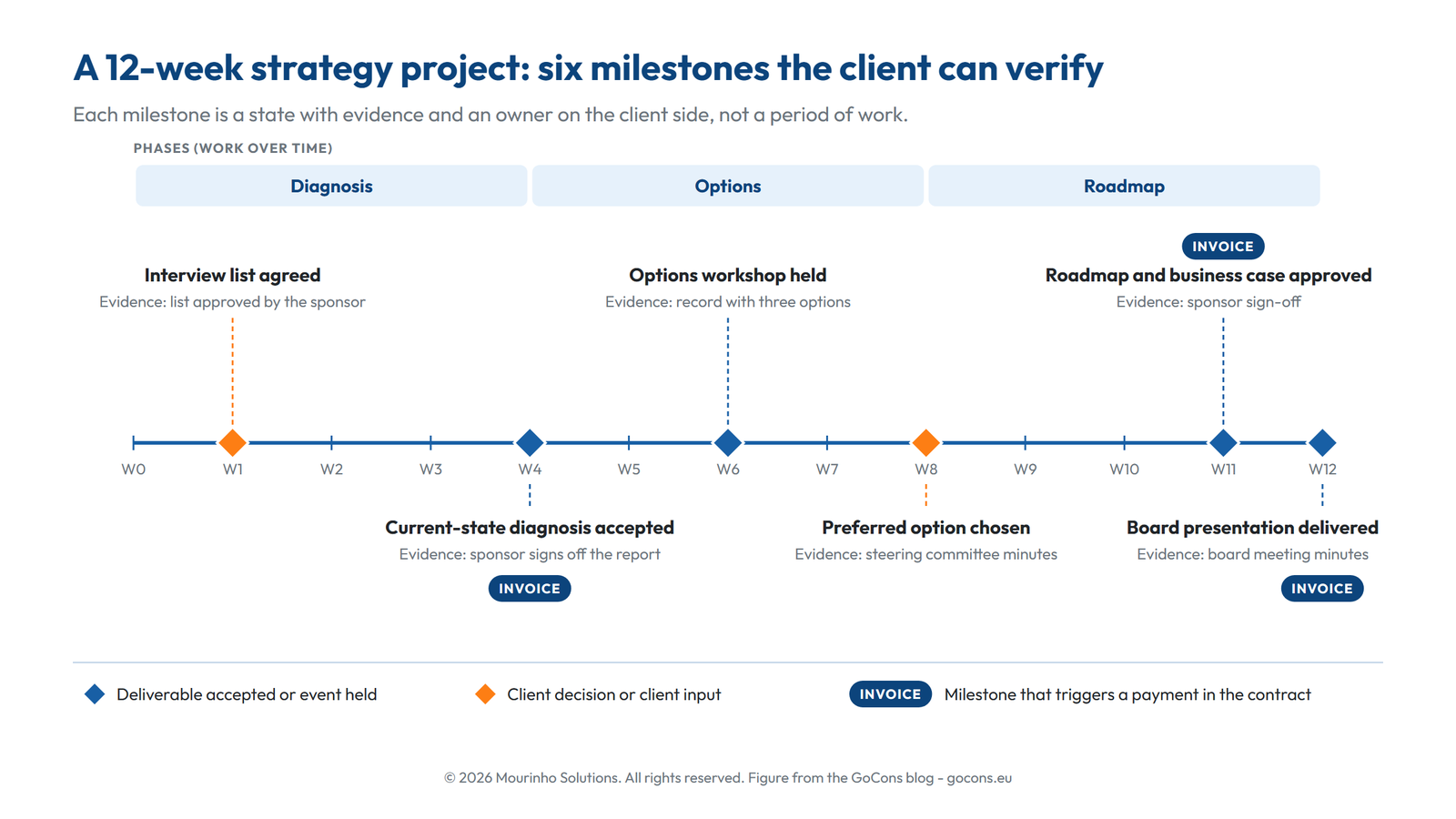
- Deliverable milestones: a report, a workshop or a system is accepted. These are the ones everybody writes.
- Client decision and input milestones: "Content delivered by the client", "Preferred option chosen". They make the client's share of the plan visible. When a date slips because a data extract never arrived, the plan shows whose milestone it was, and nobody has to argue about it.
- Payment milestones: on fixed-price work, some milestones trigger invoices. Write their "done when" with the same words as the payment clause, so acceptance and payment cannot be read two ways. Our statement of work template has a milestone and acceptance section, and our comparison of time and materials vs fixed price covers when milestone billing makes sense.
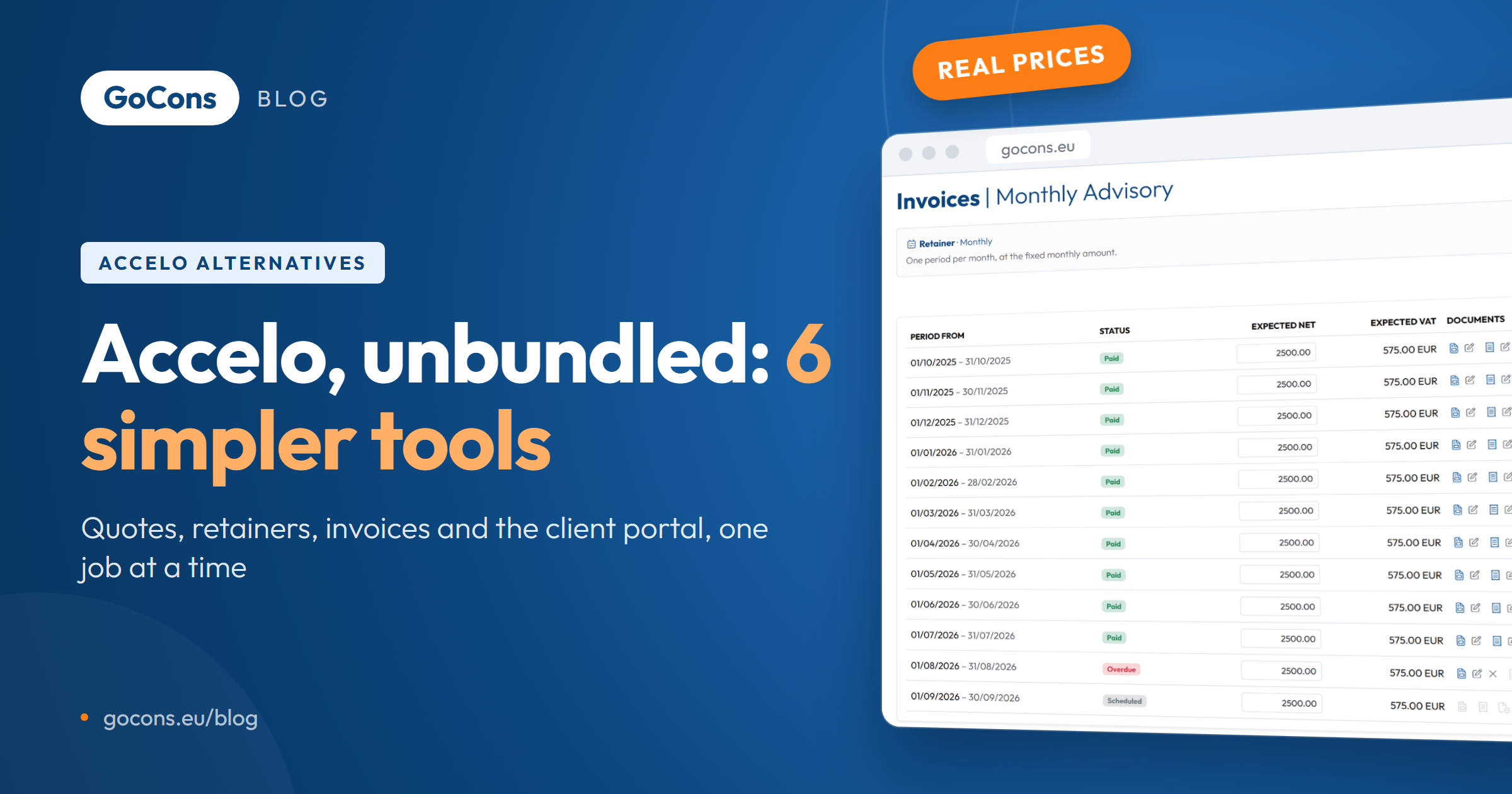
In GoCons, a contract billed by milestone gets one billing schedule line per milestone, and you attach to that line the invoice your accounting software issued. GoCons tracks invoices; it does not issue them.
Tracking milestones with your client in GoCons
In GoCons, a milestone belongs to a contract, its deadline must fall within the contract's dates, and it shows one of four statuses: Pending, Approaching in the week before the deadline, Overdue once the deadline has passed, and Completed with the date it was completed.
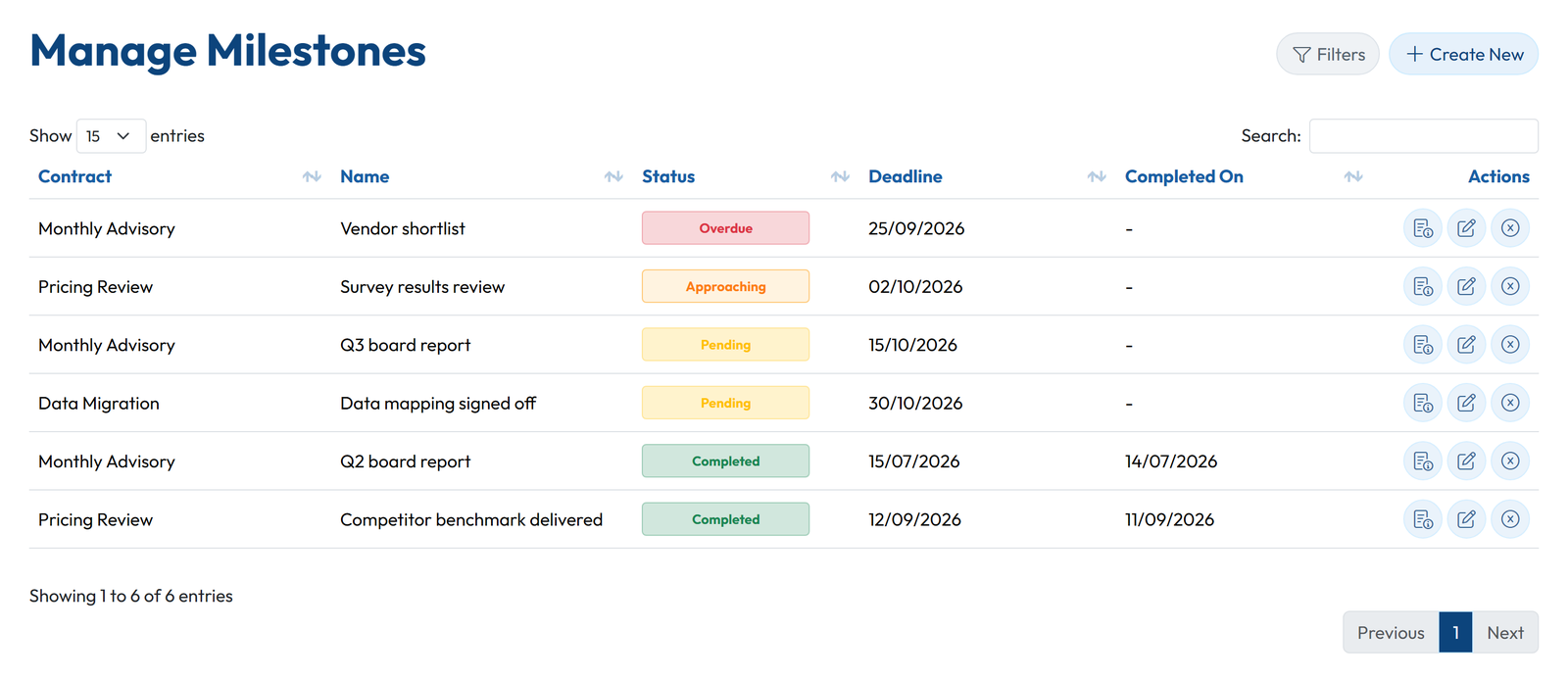
Clients see the milestones of their contracts in the client portal, and their dashboard lists the upcoming ones. When you create a milestone, the client is notified in the app and by email, so a new date never travels through a side channel. The completion date matters as much as the status: over a year, the list becomes a record of what was delivered and when, which is what you want on the table at renewal time. Each week, the status of the next milestones goes into your project status report.
There is no implementation project behind this: you create the contract, add its milestones and invite the client by email. An Admin can also ask Claude or ChatGPT (in developer mode), connected through the GoCons MCP server, to create the milestones of a new contract from the plan; a Regular User's assistant can only progress the tasks assigned to that user.
One honest limit: GoCons shows milestones as a dated list with statuses, not as a Gantt chart. For a consulting project with five to eight milestones, the list is the clearer view. If your plan depends on a dependency network, keep that in a scheduling tool and put the milestones in GoCons, where the client sees them.
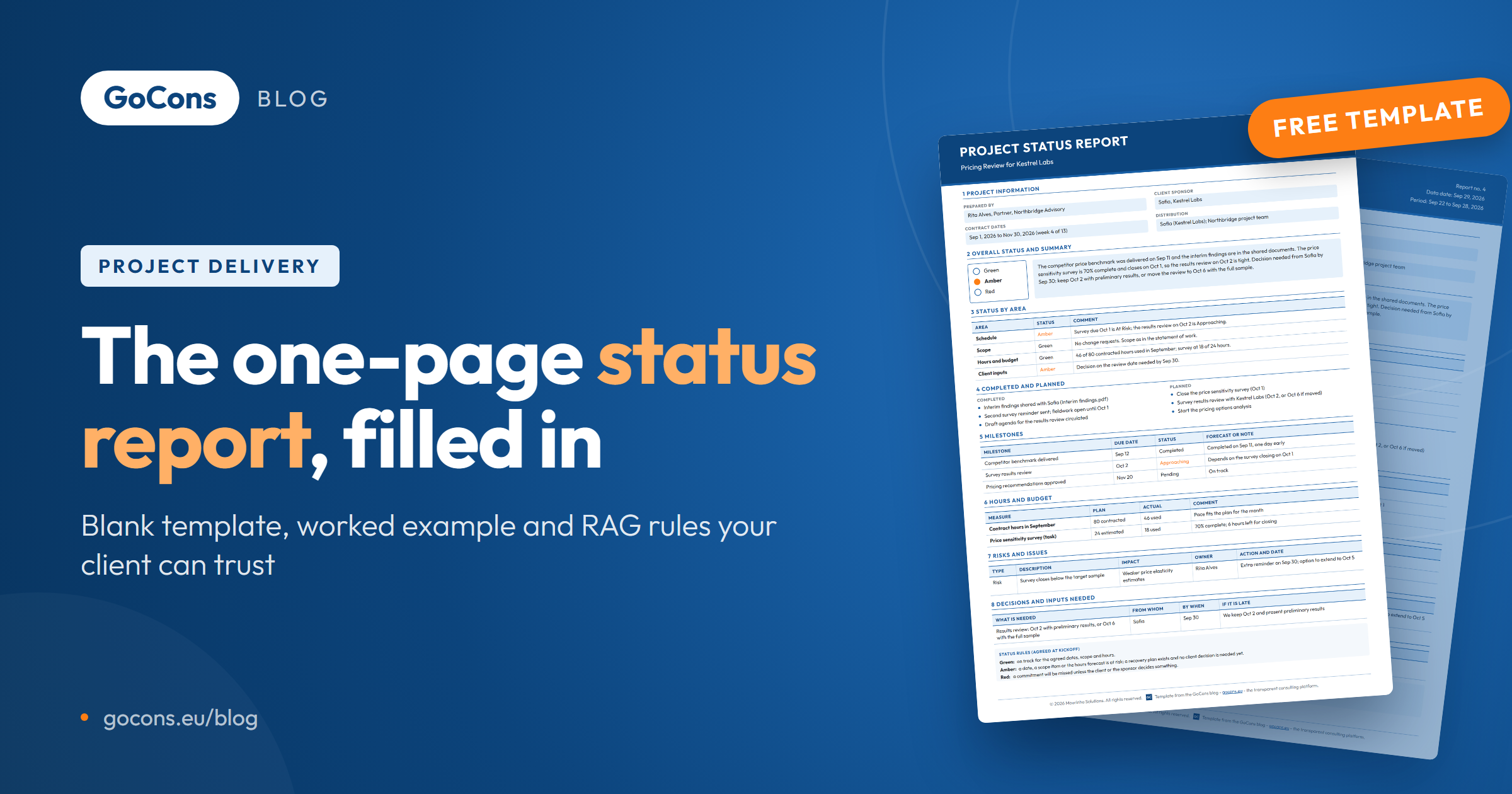
Rebuilding this report every week? In GoCons your client follows tasks, milestones and hours as they change, so the report shrinks to the decisions you need. Free to start, no card needed.
FAQ
What is the difference between a milestone and a deliverable?
PMI defines a deliverable as a unique and verifiable product, result or capability [1]. The milestone is the moment it is accepted: "Diagnosis report" is a deliverable, "Diagnosis report accepted by the sponsor" is a milestone.
How many milestones should a consulting project have?
Enough that the client sees something finished every two to four weeks. On a three-month project that usually means five to eight.
Should every milestone trigger a payment?
No. Tie payments to the two to four milestones that carry real value for the client, and keep the others for steering the work.
Does my client pay or install anything to see milestones in GoCons?
No. Client users are free and unlimited on every plan and log in from a browser. GoCons is priced per consultancy, not per user; at the time of writing (October 2026) there is a free plan, and current prices are on the pricing page.
What happens to my milestones if I stop using GoCons?
The Admin can download everything at any time, on any plan: every contract with its tasks, milestones, billing schedule and history as Excel files, plus all documents, in one zip.
Put your next milestones where the client can see them
Take your next project, rewrite its milestones as states with evidence, add them to a contract and invite the client's sponsor. The next "are we on track?" gets answered before anyone asks: create your free GoCons account.
References
- Project Management Institute, "PMI Lexicon of Project Management Terms" (milestone, milestone schedule, deliverable), https://www.pmi.org/standards/lexicon (accessed October 2026).
- Project Management Institute, "A Guide to the Project Management Body of Knowledge (PMBOK Guide), Sixth Edition: milestone list", https://www.pmi.org/standards/pmbok (accessed October 2026).
- Project Management Institute, "Milestone planning--a different planning approach" (Erling S. Andersen, PMI Global Congress 2006, Asia Pacific), https://www.pmi.org/learning/library/milestone-different-planning-approach-7635 (accessed October 2026).
- Harvard Business Review, "The Power of Small Wins" (Teresa M. Amabile and Steven J. Kramer, May 2011), https://hbr.org/2011/05/the-power-of-small-wins (accessed October 2026).
© 2026 Mourinho Solutions. All rights reserved.